
A Metre a Month – David’s Stories
This article was first published in the Valley Voice Lifestyle Magazine
‘How fast does it grow’ is a common question at Kaipara Coast Plant Centre, and it seems that people have a built-in mental barometer of what is an acceptable growth rate. An acceptable growth rate it turns out for trees is 1m a year. If a tree is capable of reaching the ‘magic metre’, then it has a high chance of being taken home and planted. The poor ‘slow and steady wins the race’ varieties don’t stand a chance against more vigorous varieties.
A metre a year is not always a good thing – a metre a year hedge means a lot of annual trimming, and a lot of trimming means a lot of foliage to clean up.
There are however some trees capable of far more than one metre a year.
Pine trees being an obvious example – if you want a fast-growing shade tree in your paddock, you can’t go past a pine tree – three to four metres in a year is quite possible. Yes, they are common. Yes, they are ugly. Yes, your neighbours will think you are a cheapskate who was too tight to trundle down to a big tree nursery to spend big money on a large grade tree.
But if your shade deprived stock need a big tree to shelter under within 4-5 years, a pine tree will do the job. An evergreen Magnolia would be much prettier, but if you or your stock don’t have 30 years left on your time clock, then the humble pine will do the job in almost every circumstance, and cost less than $10.
Poplar trees also look great as a fast, tall shade tree, can comfortably hit the 3-4 metre a year growth rate in a damper soil, and at least can give you some autumn leaf colour. They do drop their leaves in winter, but at least that lets the light in, and the grass underneath will keep growing in the winter.
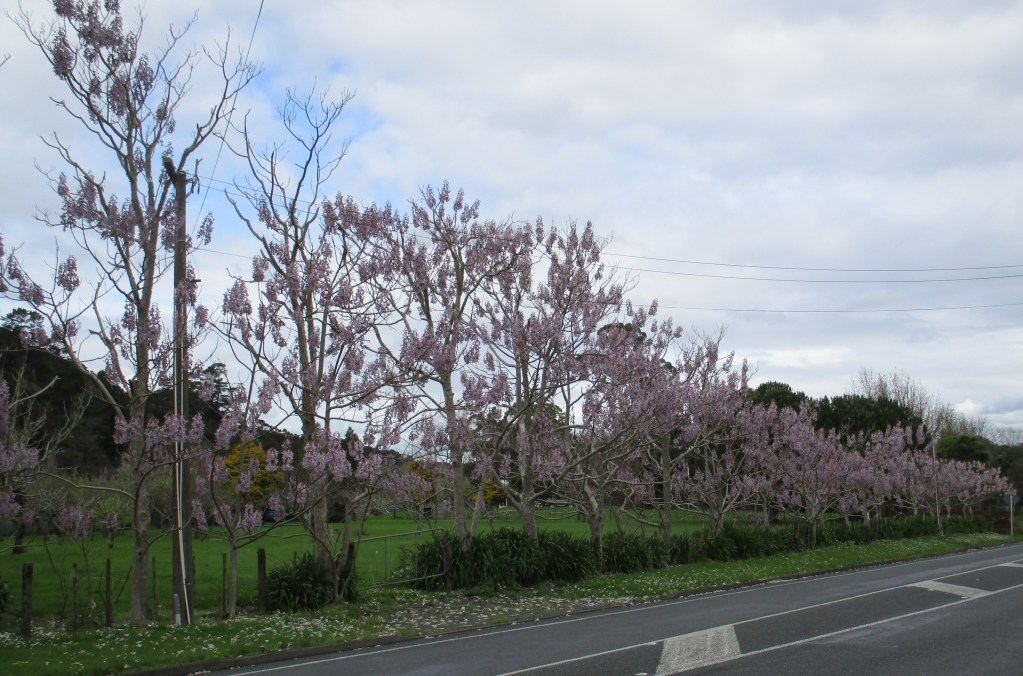
The overall winner in the drag race to the sky would have to be the Paulownia, also known as the Foxglove tree. Give it deep rich fertile soil, some water over summer, and a sheltered site, and a Paulownia tree can achieve a metre a month of new growth between November and March.
Widely promoted in the late 1980’s as a ‘get rich quick’ tree, with ultra-light timber similar in weight to Balsa Wood. The Paulownia never quite reached its potential to be a genuine ‘Money Tree’, partly due to poor site selection, but mainly due to the chances of getting rich quick in any horticultural, farming or forestry operation being very low.
However, given the right site, the Paulownia will give you a stunning display of beautiful large scented purple flowers in the spring (bees and tuis love them) with huge tropical looking leaves in the spring and summer, and an incredible growth rate. There are some unexpected downsides to such fast growth, but why let root suckers popping up everywhere in your garden and soft brittle branches snapping off every big wind spoil a great story!


You must be logged in to post a comment.